

A case study of Hatakeyama Printing Co., Ltd., which has installed the CJV200-130 was published in the label industry newspaper "Label Shimbun" , No. 1370 (August 15, 2026 issue).
The following is the published article in its original form.
Hand-Applying Large and High-Volume Labels: Turning "Can’t" into Business
Hatakeyama Printing Co., Ltd. (Yokkaichi-shi, Mie; President: Sumitsuna Hatakeyama) is a printing company founded in April 1918. Rooted in the local community, it has shifted its core business with changing market needs, from letterpress to business form and sheet-fed offset printing.
In recent years, it has strengthened its high-mix, low-volume capabilities with sheet-fed digital presses and inkjet printers (IJP). Experienced staff can manually apply several thousands labels within a short timeframe, while the sign business covers everything from printing to vehicle wrap installation.
This article explores the company’s evolution and its efforts to meet needs that others may find difficult to handle.

President Sumitsuna Hatakeyama
Yokkaichi is an industrial city centered on a major petrochemical complex. Growing with the city, Hatakeyama Printing has adapted its business to changing market needs and marks its 108th anniversary this year. Founded by the president’s great-grandfather, the company has been passed down through four generations. Today, it handles forms and public-sector documents, small-lot label printing and manual application, as well as sign printing and vehicle wrap installation.
"We have always gone beyond printing itself to solve our customers’ problems. Those efforts have shaped the business we have today," says the president. True to his words, the company’s history goes beyond traditional printing.
In its early years, Hatakeyama Printing produced envelopes and office supplies using letterpress. As the Yokkaichi petrochemical complex developed, the previous generation expanded into business form printing and later introduced a rotary forms press. Growing demand from companies and factories in the area, including the Mitsubishi Group, helped drive the company’s growth.
However, as businesses increasingly went paperless, demand for business forms gradually declined. The equipment was specialized for form production and difficult to use for other printing applications. Looking ahead, the company once again shifted into a new field. In 2004, it introduced a Ryobi sheet-fed offset press and moved into color printing for business cards, flyers, catalogs, and labels. Labels, particularly for industrial products, later became one of the company’s core businesses.
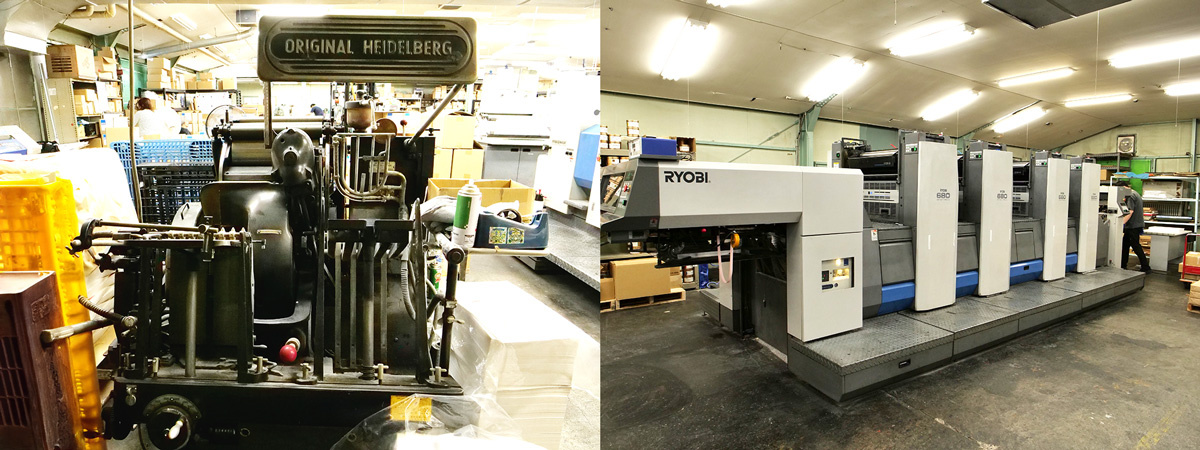
Heidelberg letterpress and Ryobi sheet-fed offset press, both still in operation.
However, offset presses designed primarily for commercial printing on cut sheets are not ideally suited to adhesive paper. Adhesive can seep out and soil the blanket, requiring frequent cleaning and adjustment based on the print volume and material condition. Knowing when to clean the blanket also depends on operator experience.
The company goes beyond printing labels to provide label application services. One example is Japanese-language labels for imported spray cans from a foreign manufacturer. The opportunity arose when the previous supplier could no longer handle the work and the customer approached Hatakeyama Printing for a solution.
The labels cover most of the can and total around 4,000 pieces. When an automatic labeler is not practical due to equipment, cost, or volume requirements, manual application becomes a realistic option. Drawing on skills developed through commercial printing, experienced staff apply each label by hand, completing the job in about five working days for delivery within roughly a week.
As fewer companies handle label application and assembly work, Hatakeyama Printing sees these jobs as an area where it can use its strengths. By bringing in skilled workers as needed and quickly organizing a team, the company is expanding its role beyond printing.
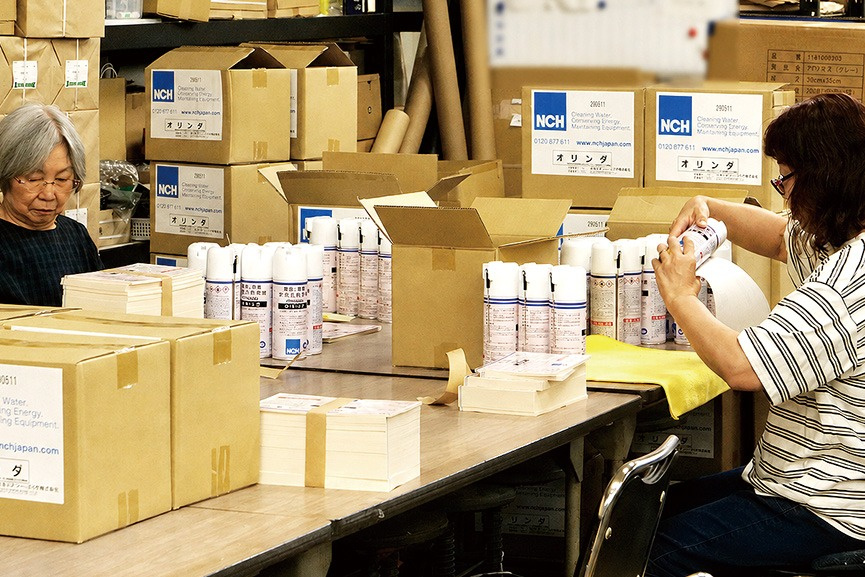
Experienced staff apply labels to around 4,000 products in approximately five days.
Adapting to Smaller Print Runs with Digital Printing
In addition to its hands-on capabilities, the company has also adapted its equipment to smaller print runs. As order volumes have fallen from 1,000 copies to 500, 100, or even 50, more jobs have become unprofitable on equipment designed for mass production.
Facing aging sheet-fed offset equipment and difficulties using simplified plate materials "Silvermaster," while demand for color printing and shorter lead times increased, the company introduced Fujifilm Business Innovation’s sheet-fed digital press "Revoria" about 10 years ago. Today, it is used for business cards, envelopes, forms, and small-lot labels.
Industrial labels are produced using either the digital press or conventional equipment, including product labels, shipping warnings, and process-control labels.
Some were previously outsourced, but as orders fell to 100 or even 50 A4 sheets, outsourcing became less economical. The company therefore brought production in-house using the sheet-fed digital press, flatbed cutting, and shavings removal, enabling very small runs of 10 to 50 sheets.
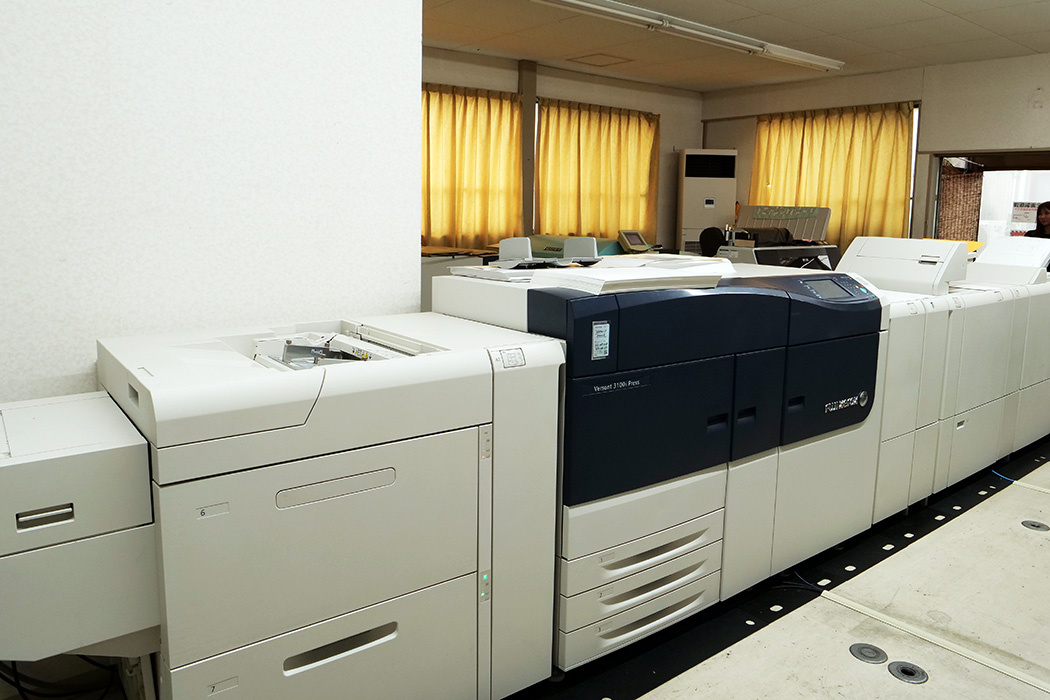
Sheet-fed digital press for small-lot printing of labels, business cards, and more.
Another digital machine supporting small-lot production is an inkjet printer with print-and-cut capability, adopted even before the sheet-fed digital press.
Around 15 years ago, as business form sales declined, the president began exploring the sign and display market. A car enthusiast who enjoyed making his own stickers, he first bought a cutting plotter for around 50,000–60,000 yen and gave the stickers to friends to test demand, receiving a stronger response than expected.
He then visited a manufacturer’s showroom in Nagoya to evaluate the equipment and output samples. Convinced that small-lot sticker production could become a viable business, the company introduced a Roland D.G. inkjet printer. "It wasn’t an impulse purchase. I did a great deal of market research myself," the president recalls.
The company’s in-house prepress and data creation capabilities also helped launch its inkjet business. By adapting existing print data to create cut lines, it was able to move into production quickly after installing the equipment.
The sign business, which began with stickers, expanded into vehicle wrapping for commercial trucks, municipal vehicles, and community buses. The company also provides full-service production from printing to installation, including full wraps for school lunch delivery trucks.
Inkjet printing has also expanded from signs to small-lot labels and stickers, especially for difficult materials and applications requiring weather or water resistance. To support these needs, the company replaced its older Roland D.G. machine with a new Mimaki inkjet printer.
Expanding Inkjet Applications for Weather- and Water-Resistant Printing
The inkjet printer used for stickers, signs, and small-lot labels for around 15 years was nearing the end of parts support and experiencing frequent breakdowns.
"We couldn’t afford to stop our small-lot label and vehicle wrapping work," says the president. After comparing machines from several manufacturers at exhibitions such as IGAS, he selected Mimaki’s CJV200-130 based on price, operability, and model age.
After training on operation, RIP software, and cutting, the company moved into full production within about a week with dealer support. While basic operation was similar to the previous machine, the RIP-based output control offered greater flexibility.
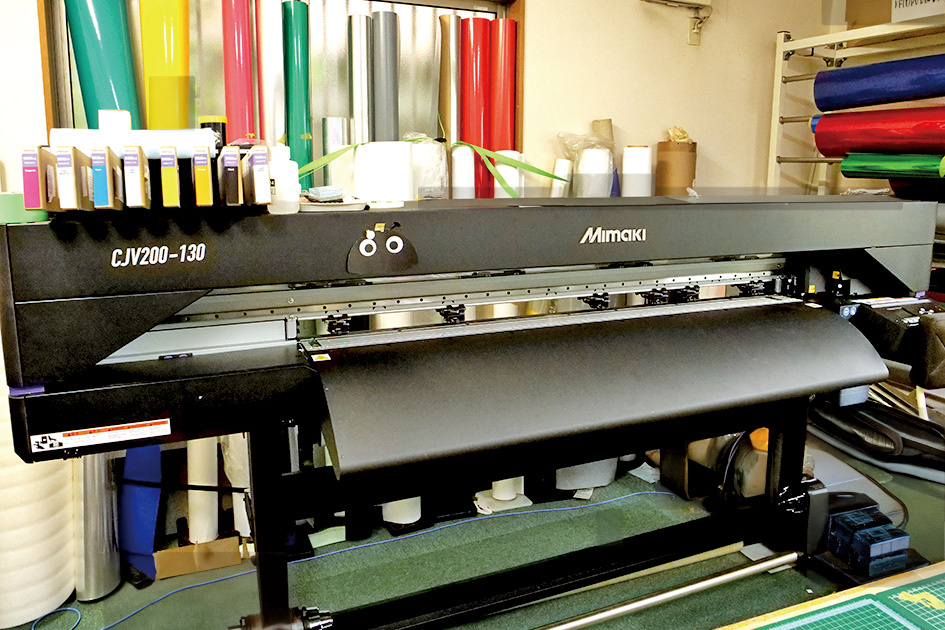
Mimaki’s CJV200-130 inkjet printer
The president particularly values the ability to fine-tune drying conditions. If prints are wound before fully drying, the printed surfaces may stick together. With the CJV200-130, the waiting time between printhead passes can be adjusted in one-second increments.
"For designs with large solid areas, I might set it to three seconds, while one second may be enough for others. It directly affects quality, and as a printer, I can judge the necessary drying time by looking at the design," says the president.
Hatakeyama Printing also applies its long-standing knowledge of ink coverage and drying from offset printing to inkjet production. The company also values the CJV200-130’s color reproduction, particularly its ability to produce vivid orange tones that are difficult to achieve with conventional printing.
While standard labels are still produced on its sheet-fed offset press, the CJV200-130 is used for very small runs, special materials, and water-resistant labels. One example is food labels for products transported long distances under frozen conditions. These labels must resist low temperatures and moisture, yet orders are often only 200–300 pieces. The company uses inkjet printing to handle such specialized, low-volume jobs efficiently.
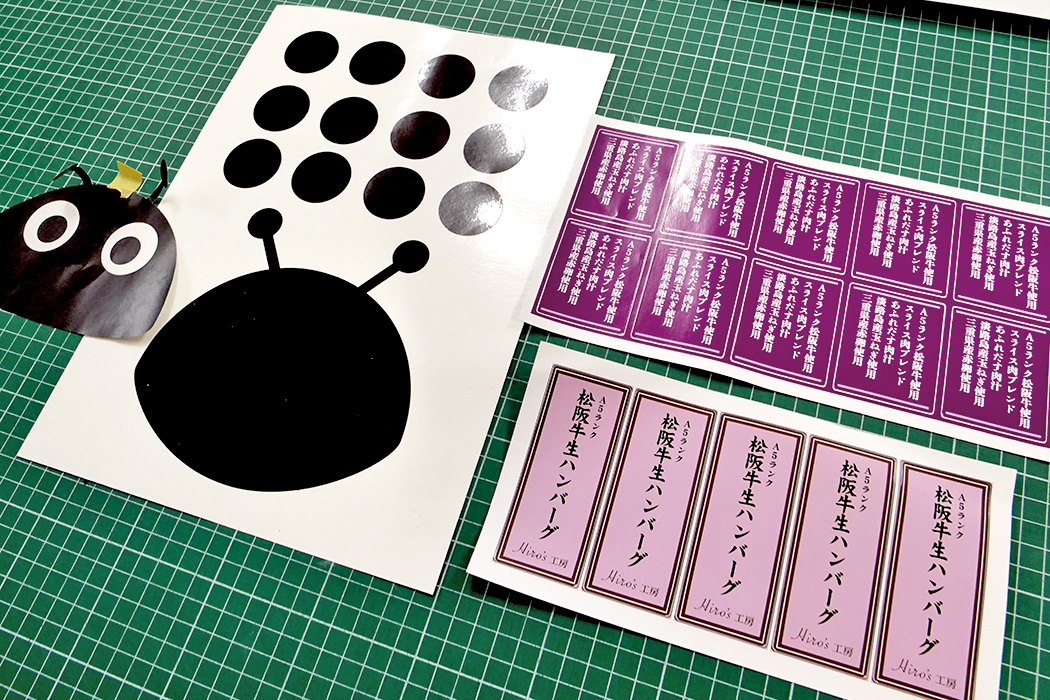
Decorative helmet stickers and water-resistant food labels for frozen, long-distance transport, produced with Mimaki’s CJV200.
The company also handles B2C work, responding to detailed requests such as custom car stickers featuring portraits drawn by children for their fathers. In some cases, even a single-order request can be produced in multiple copies at a similar cost due to material use and production efficiency. The company may suggest extra copies as gifts for grandparents, which customers appreciate. By combining printing with cutting, shavings removal, application, and installation, Hatakeyama Printing adds value beyond output alone.
Across Japan, many small printing companies are scaling back production due to succession issues and the burden of equipment upgrades. The president says similar trends in Mie are increasing inquiries about small-lot printing and specialized processing.
From letterpress to business forms, sheet-fed offset, POD, labels, signs, displays, and installation, Hatakeyama Printing has continued creating new business in response to change.
"As print volumes continue to decline, we want to stay flexible and support our customers by meeting a wide range of needs," says the president.
Going forward, the company will continue using sheet-fed offset, digital presses, and inkjet printers according to each job, expanding its role beyond printing alone.
User profile
- NameHatakeyama Printing Co., Ltd.
- IndustryFull-color printing, continuous forms and other general printing services, vehicle wraps, signage production etc.
- Address2-13-20 Nishiura, Yokkaichi-shi, Mie, Japan
- Phone number+81-59-351-2711
- URLhttps://www.cty-net.ne.jp/~hpc-ltd/
Related articles
- The Proven Performance of the "CJV200" Entry Model, Combining High-Quality Output and Ease of Use:SAN GRAPHICA Inc.

- Image quality, productivity, and weather resistance are all achieved at an unprecedentedly high level: Kumazawa screen printing, inc.
- From Life-Size Panels to Seals and Stickers: Size-Flexible Applications Expand In-House Production and Boost Repeat Orders: REC Corp.