

Standing Apart from Competitors—High Durability and Easy Application Open New Business Opportunities
―― How a Label-Printing Die and Plate-Making Company Builds a Competitive Edge with the UJV300DTF-75
Founded in 1980, Funamizu Hagata Seihan Co.,Ltd. provides a one-stop service for the dies, plates, and artwork essential to label printing. Its strength lies in producing dies with minimal variation and highly reproducible plates tailored to the equipment used by each printing company it serves. By handling these processes together, the company not only simplifies ordering, but also helps prevent misalignment between dies and plates and significantly reduce total costs, supporting label printing and finishing behind the scenes for many years.
In 2008, responding to customer demand for simple proofing and small-lot production, the company entered on-demand printing as a new business. At a time when digital printing had yet to gain widespread use in the label industry, the company decided to adopt inkjet printing ahead of competitors, leveraging its Adobe Illustrator data preparation skills developed through plate-making. With little knowledge of printing equipment at the time, the company followed advice from a trading company and introduced Mimaki’s "CJV30-60" solvent printer. The decision proved highly successful.
Major printing-company customers praised the CJV30’s vivid color reproduction and weather resistance beyond expectations, leading to new orders not only for small-lot labels but also for outdoor stickers. The CJV30 went on to serve as a key production machine for more than 15 years, helping expand the company’s business.
As inkjet printing became more common in label production, the company introduced Mimaki’s UJV300DTF-75 in October 2025 to further differentiate itself. We spoke with Noriyoshi Nakamura, Manager of the Digital On-Demand Label Section, about its role in label production and the company’s business plans.
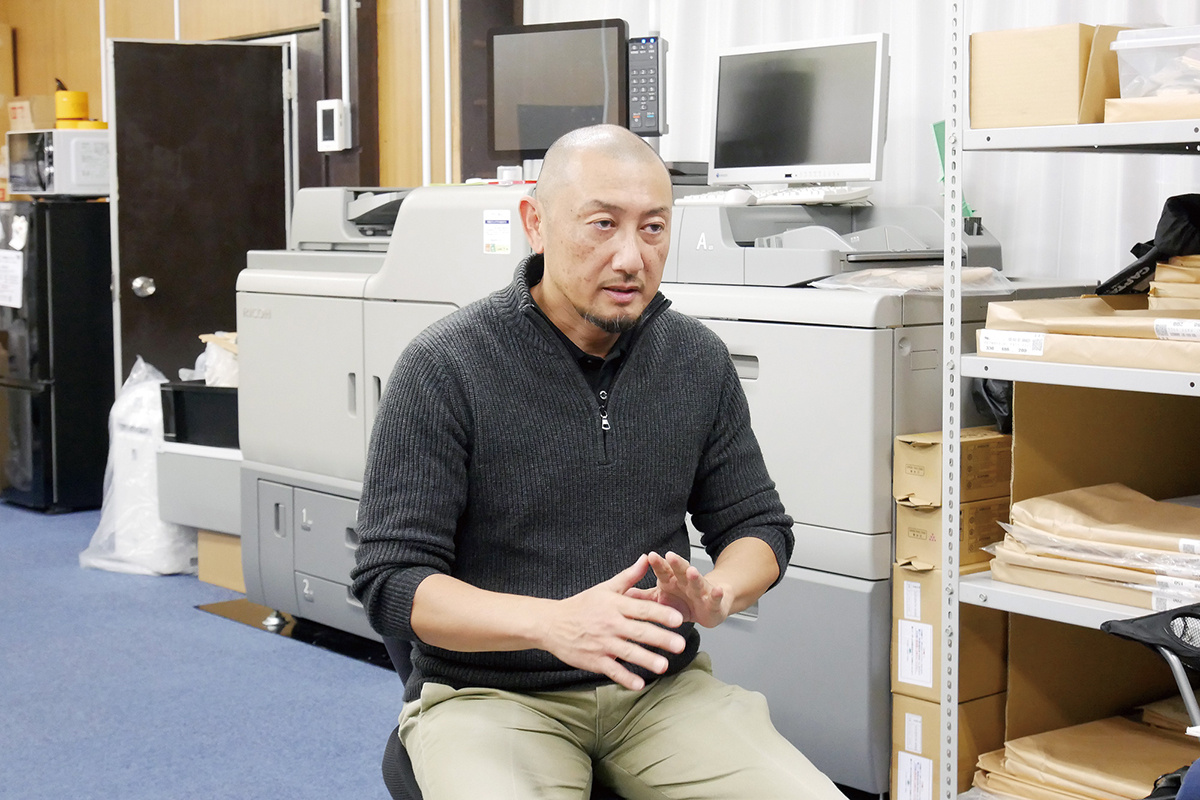
Noriyoshi Nakamura, Manager, Digital On-Demand Label Section, Manufacturing Department
― First, could you tell us your initial impression of UV-DTF?
I first learned about UV-DTF at an exhibition I happened to visit about a year ago. My first reaction was simply, "This is really interesting." I had been interested in transfer films for UV and laser printers for around 10 years, but had given up on using them commercially because the process was difficult and costly.
However, clients often dislike the transparent areas of labels because they reflect light. This is especially noticeable with corporate logos, where customers tend to prefer a finish that looks more like direct printing. So, in the past, we considered introducing a flatbed UV printer, but making jigs takes time, and complex curved surfaces are difficult to handle. On top of that, many competitors already have flatbed UV printers, so it would not really differentiate us. We expected a UV-DTF printer to solve these issues much more easily.
While gathering information for the investment, we heard that Mimaki would launch one in June, and that was when we decided to purchase it.
― Specifically, what made you decide to choose Mimaki’s UV-DTF printer?
No matter how interesting the technology is, introducing multiple units from the start would be a big risk. On the other hand, relying on just one machine raises concerns about breakdowns and downtime. That is where Mimaki gives us a great sense of security. We never have to worry about waiting months for support. If we contact them, they respond by the next day at the latest.
We have trusted Mimaki consistently for more than 15 years, ever since we introduced our first CJV30. We felt that this level of support was essential when adopting a new printing technology like UV-DTF. It may sound like a simple point, but if you imagine something like being unable to get support when a printhead needs replacing, it is certainly no laughing matter and not something you can overlook.
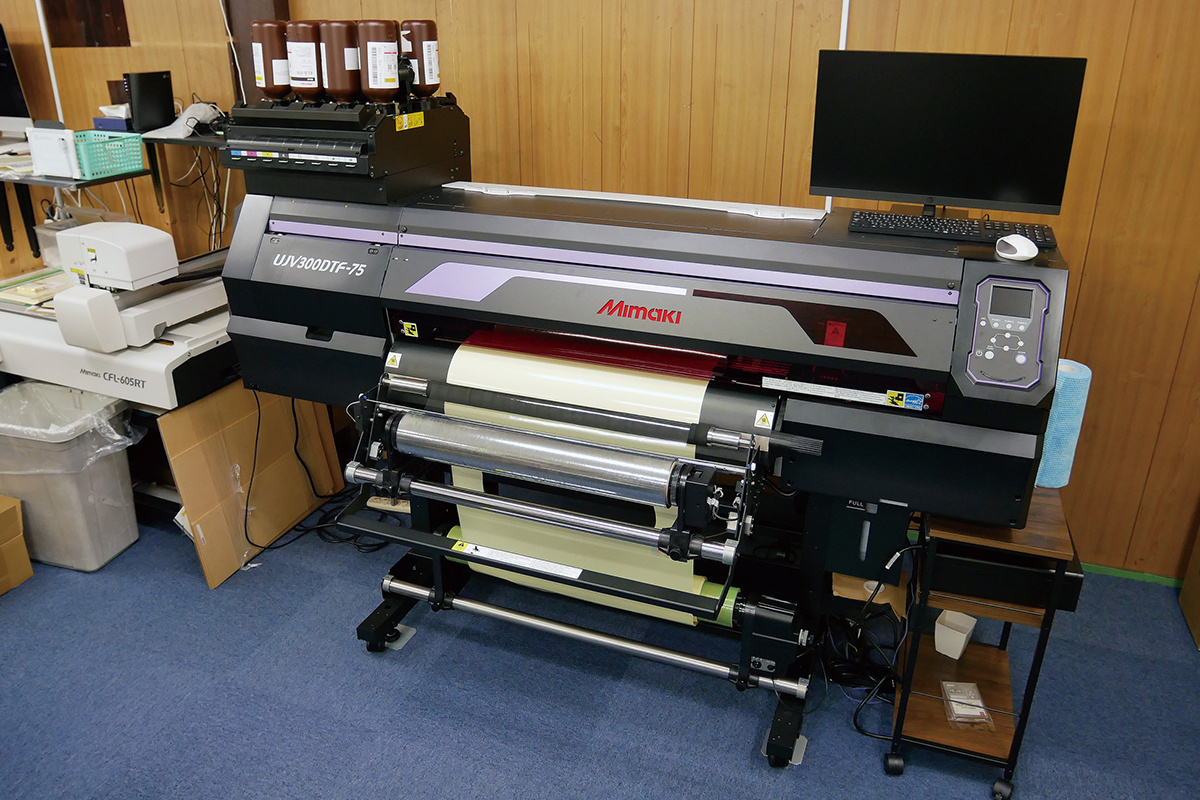
UV-DTF printer UJV300DTF-75, installed at the Funado Factory in Itabashi, Tokyo, in October 2025
― How would you rate the performance of the UJV300DTF-75?
Compared with UV-DTF printers from other manufacturers, we rated the UJV300DTF-75 highest for durability and ease of application. Our main UV-DTF business model will be to receive customer data, print it onto transfer sheets, and deliver the finished sheets. With the quality produced by the UJV300DTF-75, we felt confident that the actual application of the sheets to the target material could be left to the customer.
In other words, just like our existing die and plate-making business, we plan to supply these transfer sheets to printing companies and other businesses as auxiliary materials. If the ink peeled off easily or failed to adhere properly, complaints would be unavoidable. UV-DTF is still a relatively new printing technology, and we have seen such issues with products from other manufacturers. In this respect, the UJV300DTF-75 appears to be a step ahead, and we feel confident that these concerns can be avoided.
― I see. So with the UJV300DTF-75, you felt you could deliver the printed transfer sheets and leave the actual application to the customer.
Yes. There is no reason not to take advantage of how easy it is to apply and how strongly it adheres. The UV-DTF process is simple: apply the transfer sheet to the material and peel it off. We plan to provide an instructional video on our website, which should be enough for customers to understand the process. Even curved surfaces can be handled with a little practice.
Customers can also apply the sheets themselves and test them on different materials, so we expect new products and applications to emerge that we may not have thought of. On our website, we are promoting it as "the latest technology for materials that could not previously be printed on," under the product name "UV transfer stickers."
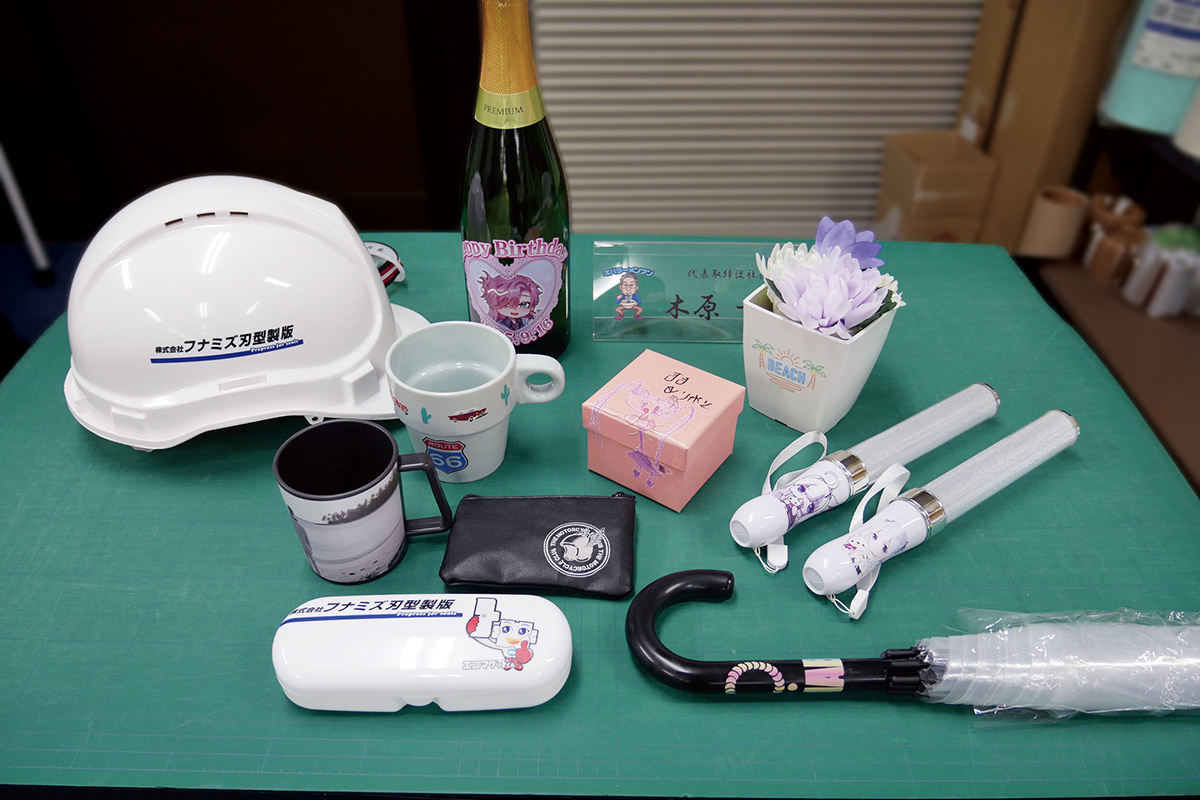
Samples produced in-house since October, including helmets, cups, cases, plates, paper packaging, and leather, have shown strong potential for the technology.
― How have you found the UJV300DTF-75 in terms of usability since its installation?
What surprised me is how similar the operation feels to the CJV30. Broadly speaking, the UJV300DTF-75 prints while peeling away the liner from the adhesive film, then automatically laminates the application sheet. Although the workflow should be completely different from that of a solvent printer, there is very little difference in actual operation.
Unlike conventional UV-DTF printers, there is no need to apply the application sheet manually, and the entire process is completed in a single print operation. It is extremely impressive.
― Finally, could you tell us about your plans for the future?
We introduced the UJV300DTF-75 with the clear goal of differentiating ourselves from competitors. These days, competing on the same terms as everyone else often leads to price competition. I believe this printer is a unique and exciting machine that can change that situation.
We hope to turn that uniqueness into one of our strengths, generate inquiries from new customers, and ultimately help grow our existing business as well. If you are interested in the UJV300DTF-75 but hesitant to introduce one right away, we would be happy to let you try it with us first. Please feel free to contact us.
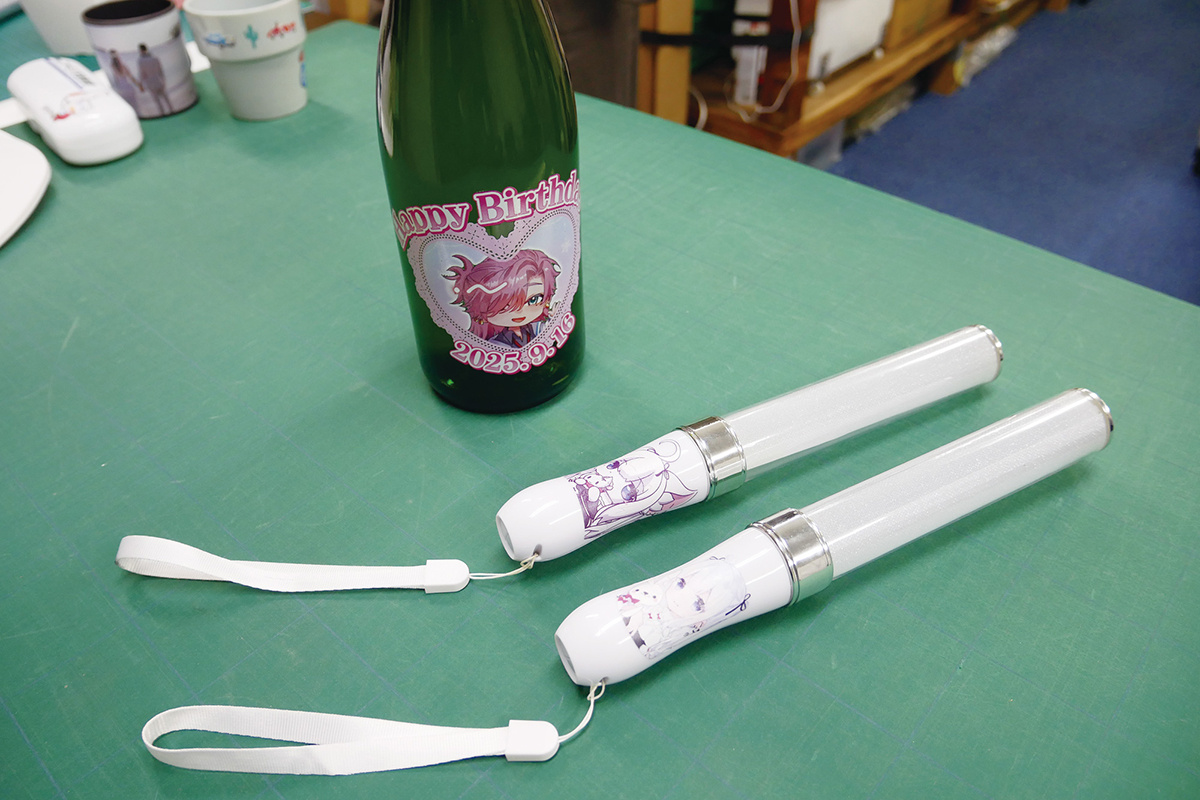
The company has also prepared easy-to-understand fan merchandise, such as custom champagne bottles and glow sticks. Even on narrow handles designed to be held by hand, the transfer sheets can be applied with ease.
User profile
- NameFunamizu Hagata Seihan Co.,Ltd.
- IndustryManufacture of steel rule dies, die-cutting molds, artwork preparation, design, small-lot sample label production, and etc.
- Address3-3-25 Sakaecho, Asaka-shi, Saitama, Japan
- Phone number+81-48-465-2140
- URLhttps://www.hagata.co.jp/
Related articles
- Greater Flexibility for Diverse Custom Merchandise Production with One Printer for High-Mix, Small-Lot Demand: Idea Ltd.
- A Powerful Tool for the Booming Sticker Market and Fan-Driven Culture - Natural Finish and Excellent Material Compatibility Expand New Possibilities for UV-DTF Printing: f.delight Co.,Ltd.
- Also recommended for the goods business! Original print by the latest UV-DTF system - A printer that "attaches the print" freely even on curved surfaces, supports various materials, and is ideal for ready-made decoration -