

Greater Flexibility for Diverse Custom Merchandise Production with One Printer for High-Mix, Small-Lot Demand.
―― A Merchandise Manufacturer Known for Local Kewpie Products Shares Its Outlook on the UJV300DTF-75
Idea, with production bases in Japan and overseas, focuses primarily on the planning and production of character merchandise. Since its establishment in 2002, the company has developed more than 10,000 varieties of Costume Kewpie products worldwide, including regional Kewpie items and collaborations with anime and TV dramas.
In 2010, Idea began producing acrylic goods, building on the product-planning expertise developed through its Costume Kewpie business. The company expanded into acrylic stands and keychains, earning customer trust through faithful character reproduction and careful finishing. It has also developed know-how to make acrylic stands that resist coming apart or falling over, pursuing quality that competitors find difficult to match. Today, acrylic merchandise for popular anime titles accounts for 70% of its total sales.
In September 2025, Idea introduced Mimaki’s UV-DTF printer "UJV300DTF-75." Seeing UV-DTF as an essential new technology for expanding its merchandise lineup, the company made an early investment to differentiate itself from competitors. With extensive experience using flatbed UV printers, what potential did Idea see in the UJV300DTF-75? We spoke with Kozue Morozumi, General Manager of the Business Administration Department, and Ayaka Kato, Team Leader of the Design Team in the Planning Department.
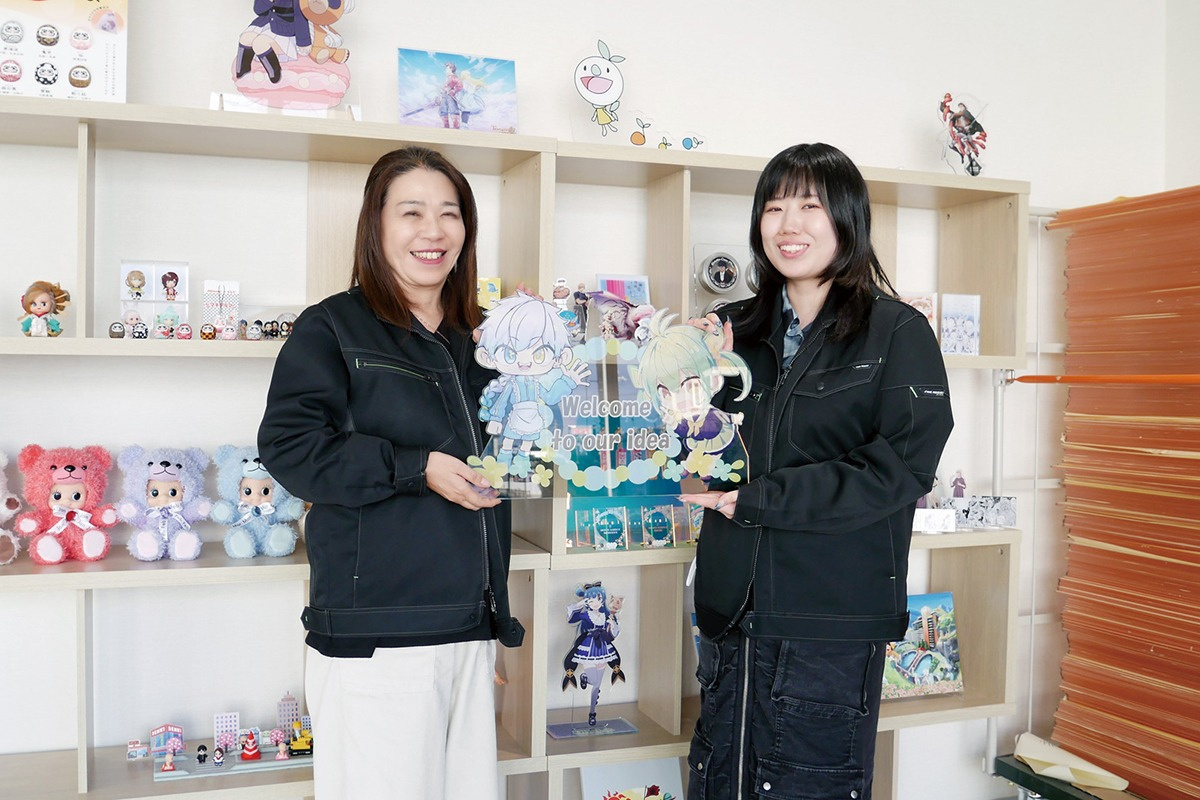
Kozue Morozumi, General Manager of the Business Administration Department (left), and Ayaka Kato, Team Leader of the Design Team in the Planning Department (right)
― First, could you tell us what led to the introduction of the UJV300DTF-75?
Morozumi: We had known about transfer sheets like UV-DTF for some time, but having to manually apply an application sheet after printing seemed like a bottleneck, making the process unsuitable for mass production. Then we heard that the UJV300DTF-75, which automatically applies the application sheet, would be launched in June. The price was also reasonable, so we thought, "Why not buy it?" and decided to move quickly (laughs). The initial investment is also lower than for a flatbed UV printer, so rather than hesitate, we felt it made sense to adopt the technology early and gain a first-mover advantage.
― What specifically made you see potential in the UJV300DTF-75? What are your expectations for it at this stage?
Kato: With the UJV300DTF-75, we expect not only to handle materials and shapes that we could not print on before, but also to respond more flexibly to small-lot orders. For example, sports teams often want merchandise printed with individual player numbers. We believe this printer will make it much easier to meet those kinds of requests.
Morozumi: In recent years, consumers have started looking beyond acrylic goods and asking for something different, so we want to offer them new possibilities. The transfer sheets can even be applied cleanly to curved surfaces, such as small daruma dolls, which should allow us to handle a wider variety of small-lot products domestically. Simply reducing our reliance on pad printing at overseas factories will significantly improve our flexibility.
Kato: Recently, "oshi-tori sticks," which are convenient for photographing acrylic stands and keychains, have become popular, and we often hear requests to print on the sticks themselves. Being able to print on such slim handles is a real advantage. We also see UV-DTF as an ideal technology for producing a wide variety of merchandise in small lots of around 100 units, such as goods for underground idols.
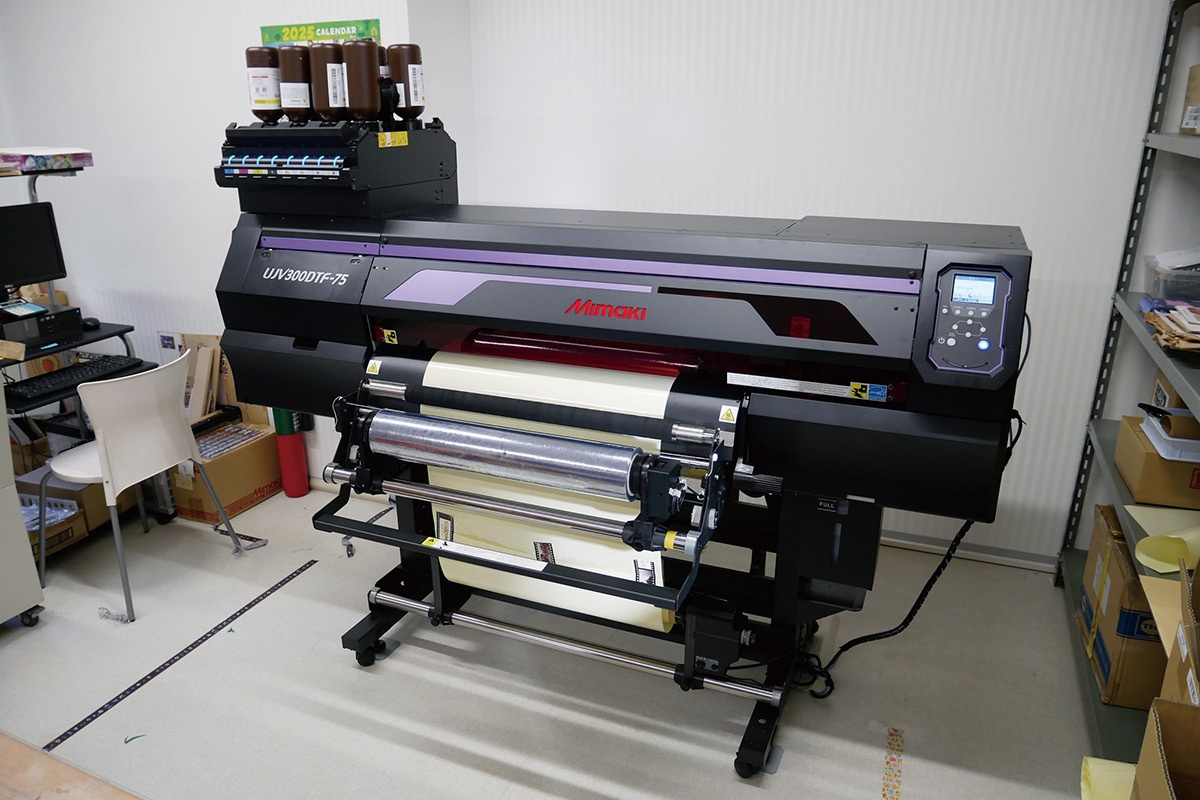
The UJV300DTF-75 UV-DTF printer, installed at the Nagano factory in September 2025.
― So you saw the UJV300DTF-75 as a way to meet diversifying market needs. How has it performed since installation?
Kato: We had mainly used flatbed printers and were less familiar with roll-to-roll models, but the UJV300DTF-75 has been surprisingly easy to operate, with little difference in usability.
Morozumi: I was impressed by how compact it is and, above all, by its distinctive color scheme. People in the company say it looks “Evangelion-like” and cool (laughs). Unlike conventional printers, it has a stylish design that changes the image of a machine simply sitting on a factory floor. At first, the term DTF made me expect something closer in scale to a T-shirt printer, but that was not the case at all. In fact, its size was one of the reasons we decided to introduce it.
― What advantages do you see compared with direct printing?
Morozumi: Yes. With conventional merchandise printing, we cannot start until the base material arrives. With the UJV300DTF-75, however, we can begin printing the transfer sheet as soon as an order is confirmed, without waiting for the material. Being able to print before the material is sourced or processed is a major advantage. By using UV-DTF and direct printing according to delivery requirements and material availability, we expect the UJV300DTF-75 to play an increasingly important role.
― How have customers responded?
Morozumi: Everyone reacts with, "Wow!" We show customers samples applied to EVA resin, and most try scratching the surface to see if the ink comes off. When we demonstrate how easily the transfer sheet can be applied and peeled away, they ask, "Is that all it takes?" Even merchandise manufacturers and trading companies are impressed by the ink’s abrasion resistance and ease of application, often sparking ideas about what else they could create.
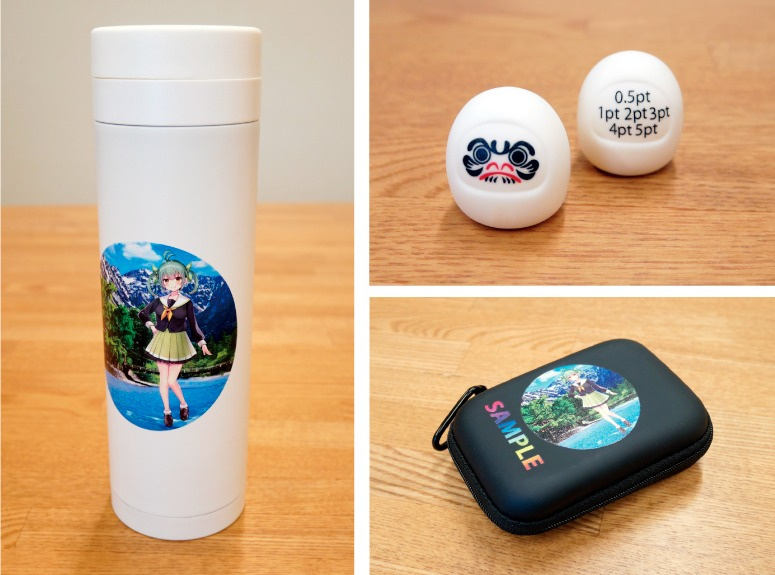
Various samples with transfer sheets applied, including a small daruma doll, coin cases, and bottles.
― That sounds promising. It seems you have standardized on Mimaki printers. Could you tell us why?
Kato: Our factory operates around the clock, so the UJF-7151 plus, plusII, and plusII e are all running at full capacity. We produce around 300,000 to 400,000 acrylic goods per month. With production at this scale, issues are inevitable, but Mimaki responds quickly whenever we contact them. During repairs, they also advise us on functions we have not yet fully used and often point out features we were unaware of. That level of support is one of Mimaki’s greatest strengths.
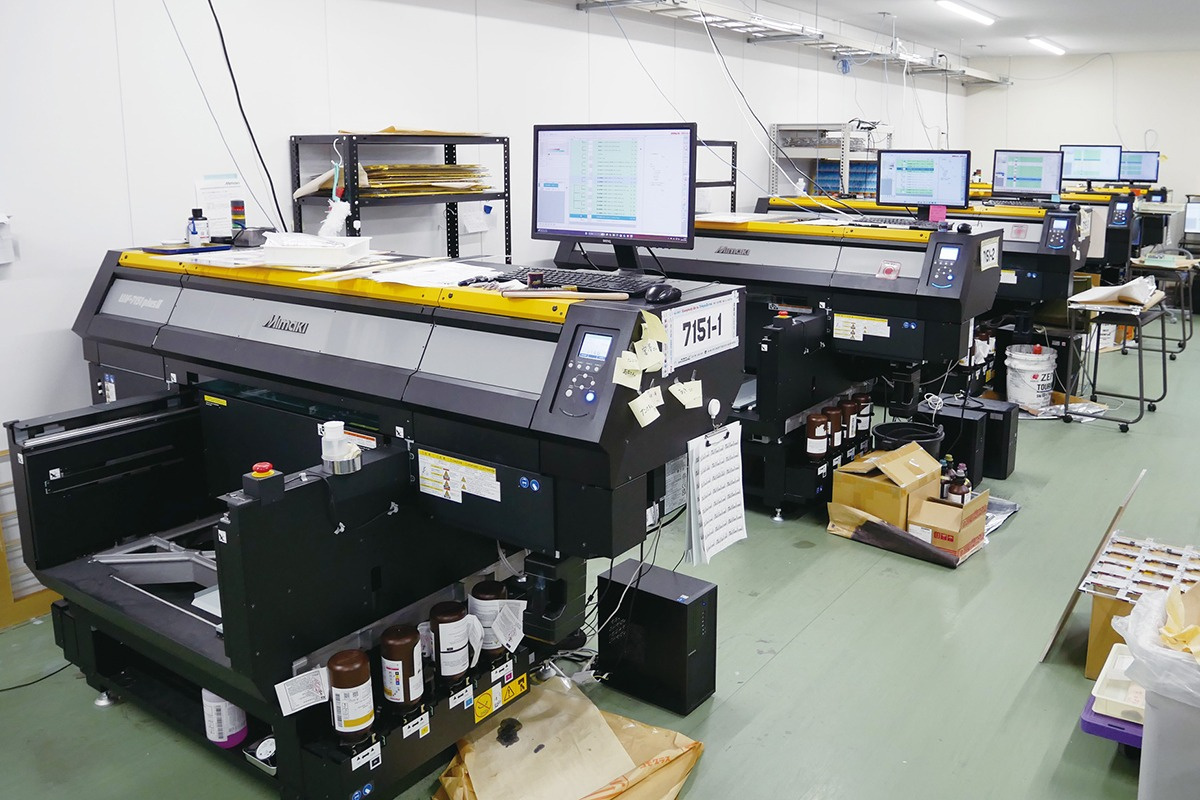
The UJF-6042 flatbed UV printer, first introduced in 2010, has long been used to print acrylic stands and keychains, with monthly production now stable at around 300,000 to 400,000 units. By adopting flexible inks in addition to rigid inks, Idea has also expanded into printing original figurines, smartphone cases, and other items. As of December 2025, a total of 10 printers are installed at the Nagano factory, including four UJF-7151 plusII units. The factory is also equipped with a DCF-605PU digital coating machine.
― Finally, what would you say to users considering the UJV300DTF-75?
Morozumi: Once you use it, you realize the UJV300DTF-75 is quite easy to operate. Even the media cost does not feel excessive when you look at the total cost. Above all, its ability to handle a wide range of substrates, including curved and uneven surfaces, is a major strength. I believe UV-DTF will continue to grow in Japan, so there is a clear advantage in adopting it early.
User profile
- NameIdea Ltd.
- IndustryPlanning, manufacturing, and importing acrylic products, Costume Kewpie® and other character merchandise; contract light assembly and related work.
- Address910 Higashiwada, Nagano-shi, Nagano, Japan
- Phone number+81-26-239-6300
- URLhttps://www.idea-ltd.com/
Related articles
- Standing Apart from Competitors—High Durability and Easy Application Open New Business Opportunities: Funamizu Hagata Seihan Co.,Ltd.
- A Powerful Tool for the Booming Sticker Market and Fan-Driven Culture - Natural Finish and Excellent Material Compatibility Expand New Possibilities for UV-DTF Printing: f.delight Co.,Ltd.
- Also recommended for the goods business! Original print by the latest UV-DTF system - A printer that "attaches the print" freely even on curved surfaces, supports various materials, and is ideal for ready-made decoration -