

Improving Reinforced corrugated fiberboard (RCF) Packaging Efficiency and Cutting Waste in Transportation and Material Costs
―― How a Regional Logistics Company Used the CFX to Bring Production In-House and Enhance Customer Service
IPD Logistics, based in Tomi, Nagano, provides community-focused warehousing, transportation and packaging services. Founded in 2004 by current Chairman Takashi Iwashita as a parcel delivery business, the company was incorporated the following year and began general freight trucking. Now in its 20th year, it has expanded into bonded warehouse operations, with warehousing accounting for about 41% of total sales.
Rather than simply storing customers’ products, IPD Logistics provides asset-based 3PL* services that optimise the entire logistics process, including efficient delivery of entrusted parts to production lines. This one-stop capability has earned the trust of many customers, including a global leader in food and beverage container moulding, which entrusts the company with full inventory management.
On October 1, 2025, the company transitioned to a holding company structure and is now exploring future expansion into fields such as food services and accommodation. To strengthen profitability in its core logistics business, it introduced Mimaki Engineering’s CFX-2550 flatbed cutting plotter that same month. The machine was seen as essential for improving Reinforced corrugated fiberboard (hereinafter RCF) packaging efficiency and accelerating the shift from wooden crates. We spoke with President Yutaka Kayama about its impact and the resulting changes in profitability.
* Third-party logistics
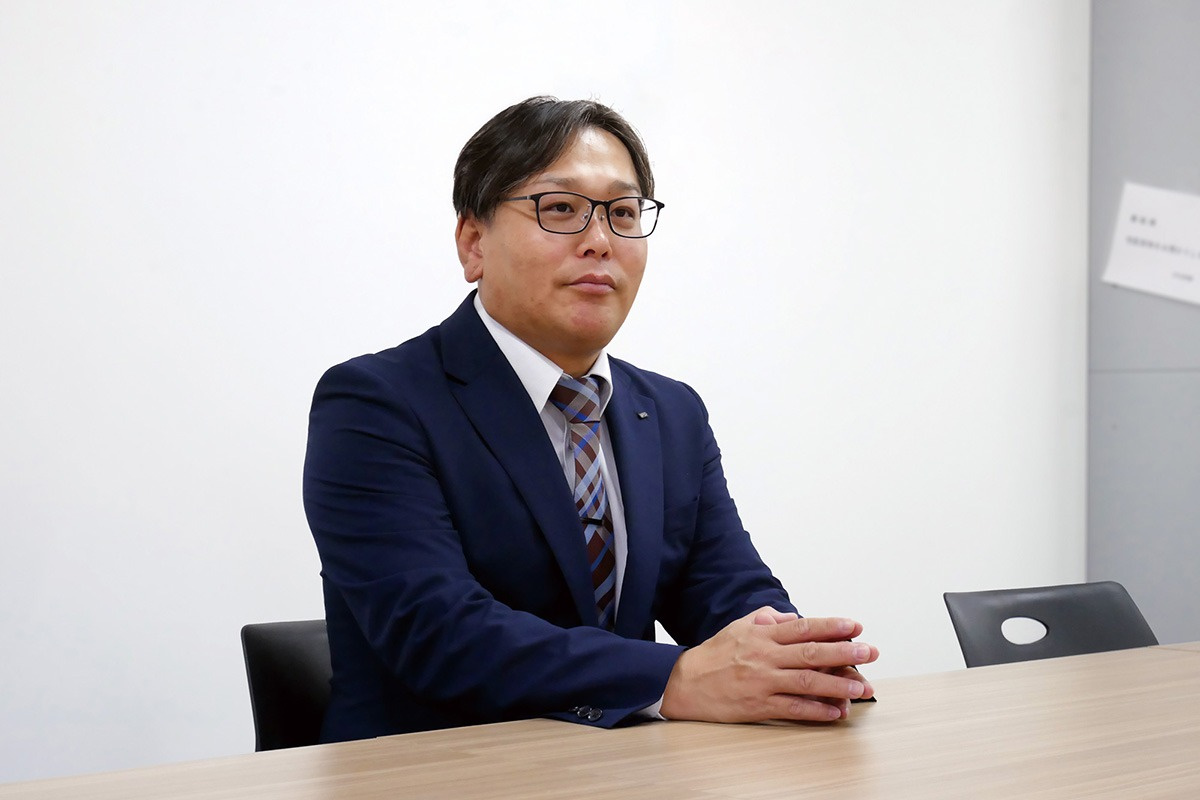
Yutaka Kayama, president of IPD logistics Co., Ltd.
― First, why are you focusing on packaging using RCF?
RCF is much lighter than wooden crates, helping reduce transportation costs. This is especially effective for air freight, where costs are weight-based. During the COVID-19 pandemic, when flights were sharply reduced and cargo space was limited, shipping costs differed by more than double between corrugated packaging and wooden crates.
It also makes packing and unpacking easier, helping shorten work time. Because no nails are required, it improves safety, and corrugated board also has an extremely high recycling rate. In addition, storage space for packaging materials in the warehouse can be reduced to nearly half compared with wood.
― I see. So it offers a range of benefits. Why, then, was the CFX-2550 necessary for expanding your use of RCF?
Initially, we sourced standardised RCF materials from partner suppliers. It later introduced another company’s cutting machine to bring production in-house, but faced issues with cost performance and productivity. As a result, it continued to rely mainly on standard materials, but lead times remained a major challenge. In many cases, it took more than 10 days from material procurement to final packing, so we had been looking for a way to improve the process.
While facing these challenges, we learned that Mimaki had released the CFX-2550, a flatbed cutting plotter capable of handling materials up to 5 m long, and quickly considered introducing it. Its lower initial cost compared with similar machines made it highly attractive. The table size was also ideal, as RCF sheets are most efficiently purchased in 4.6 m lengths to reduce unit costs.
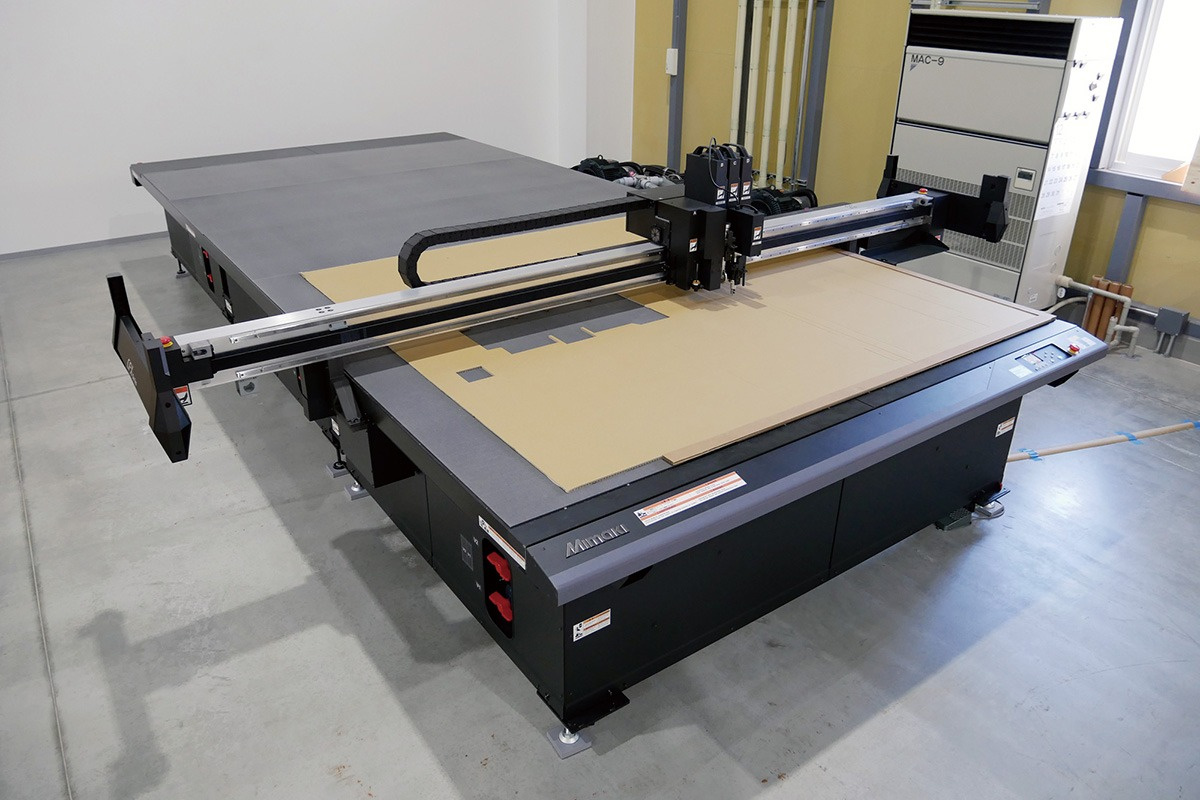
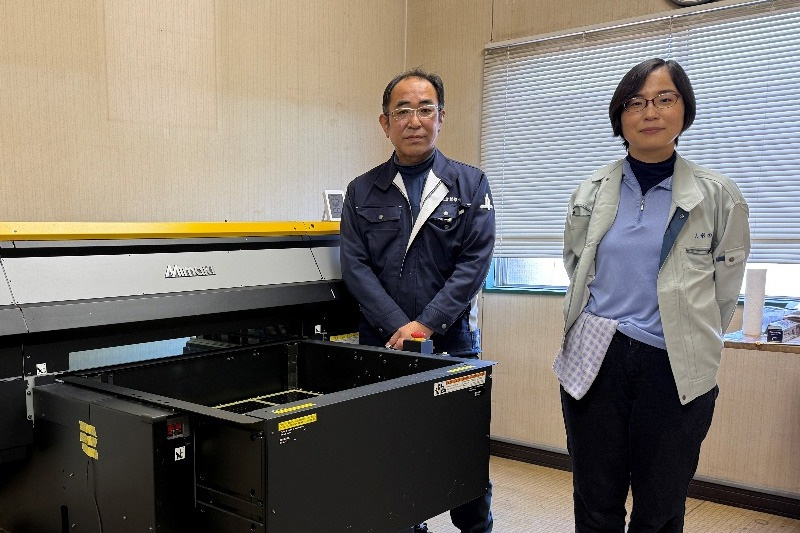
The CFX-2550 flatbed cutting plotter, which began full-scale operation in October 2025 at the Ina Sales Office in Minowa, Nagano.
― Did the introduction of the machine actually help reduce lead times?
Yes. Since introducing the CFX, we have been able to complete packaging within two to three days after receiving the goods. Compared with our existing machine, it is about 130% faster and also more accurate, contributing greatly to shorter lead times. The value of the CFX is especially clear for urgent requests, such as air-shipping maintenance parts.
Today, we process around 550 packaging materials per month with the CFX, with an average size of about 1.1 m square and 1.5 m high. Previously, outsourcing standard materials cost about 5 million yen per month, but in-house production has reduced this by at least 9%, improving profitability within just one or two months. We expect to recover the initial investment by the end of 2028, and the machine has exceeded our expectations in cost performance.
― It is encouraging that profitability improved so quickly. How has introducing the CFX helped enhance your customer service?
Yes. When packaging a wide range of customers’ products, being able to handle short-run, quick-turnaround requests and process materials to match each product size is a major advantage. If the product fits the packaging precisely, we can reduce unnecessary transportation costs and use less cushioning material. As a result, we have reduced material waste by around 15%.
With energy and material costs rising, we strongly feel that the CFX has helped us cut various forms of waste. When using standard packaging, size mismatches with the cargo still left a risk of damage, no matter how much cushioning material was used. Being able to create packaging that fits precisely gives us a level of reassurance that is extremely valuable. The CFX has helped us better protect the interests of both our company and our customers.
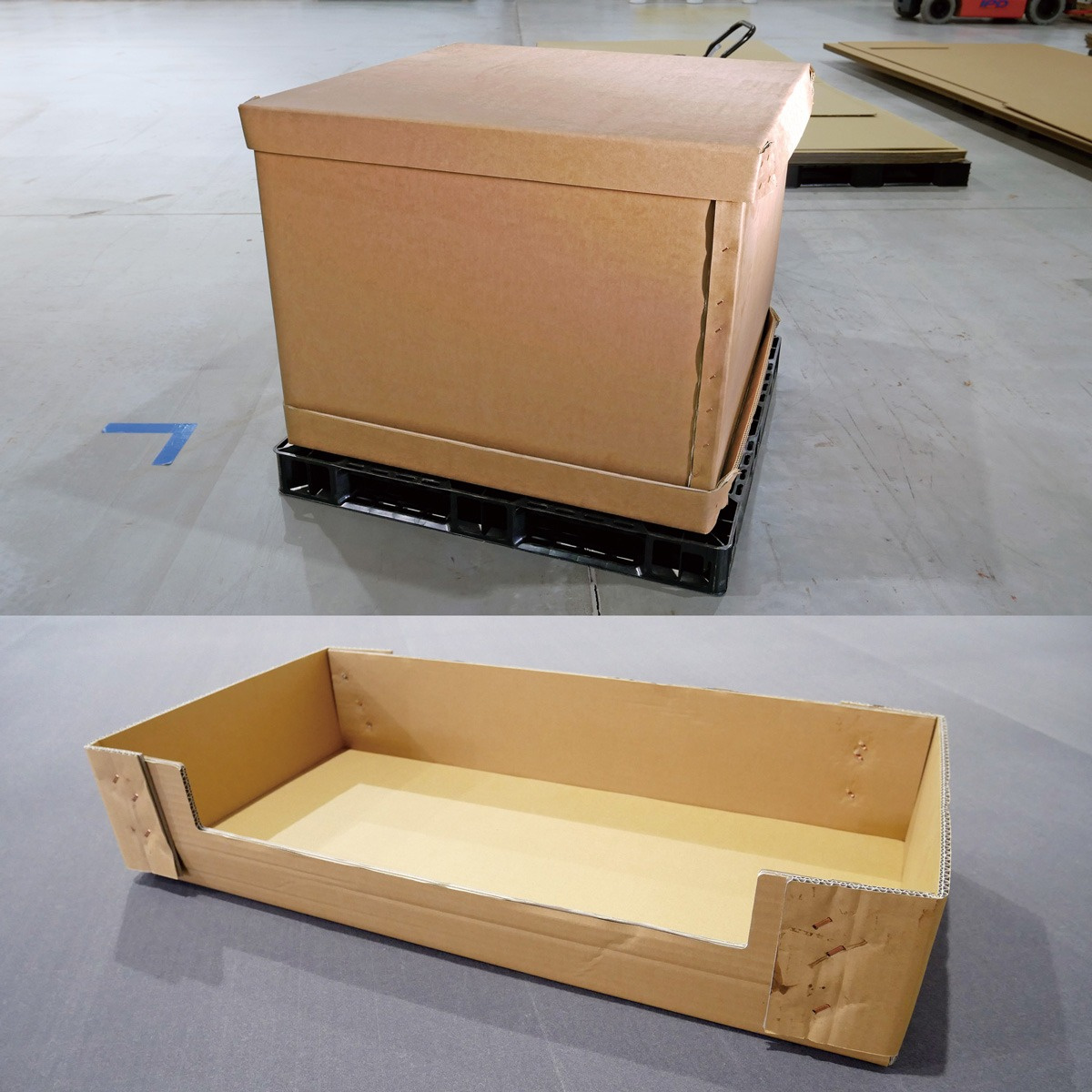
RCF (top) and a corrugated tray made from the same material (bottom). With the introduction of the CFX, the company can process packaging materials optimised for each shipment, thoroughly reducing unnecessary costs.
― How do you evaluate the machine’s usability and the support you have received after installation?
Mimaki products seem to be designed with the production floor in mind. Details such as clearly colour-coded buttons show careful attention to usability. At first, our staff were unsure whether they would be able to operate the machine, but its simple structure meant they became familiar with it in less than a week. Mimaki also provided thorough training on the workflow from exporting DXF files from Draft Board CAD software to loading them into RapidCut for cutting, allowing us to move into full-scale operation faster than expected.
After installation, we once had an unexpected issue where a blade broke and we had no spare stock, but when we contacted Mimaki in the evening, they delivered a replacement by the next morning. That really showed us how reliable their support is. Since downtime directly affects our operations, being able to trust the after-sales support is a major advantage.
― Finally, how would you sum up the impact of introducing the CFX?
We feel that the cost reductions achieved with the CFX have directly improved customer satisfaction. Being able to handle short-run, quick-turnaround requests has also led to new inquiries, such as customers asking for just a few additional packaging materials or requesting smaller, simpler versions of their existing packaging. Since few companies in our industry currently have a CFX, we feel it also helps differentiate us from competitors.
We would like to use this potential to increase the in-house ratio of RCF from the current 30% to our target of 50%. Ideally, as a community-focused company, we would also be pleased to contribute to local society in Nagano by using the CFX to prepare cardboard beds and toilets for disaster situations.
User profile
- NameIPD Logistics Co.,Ltd.
- IndustryWarehousing, freight forwarding, general freight trucking, and related services etc
- Address88-12 Kazawa, Tomi-shi, Nagano, Japan
- Phone number+81-268-63-1151
- URLhttps://www.ipd-logistics.co.jp/
Related articles
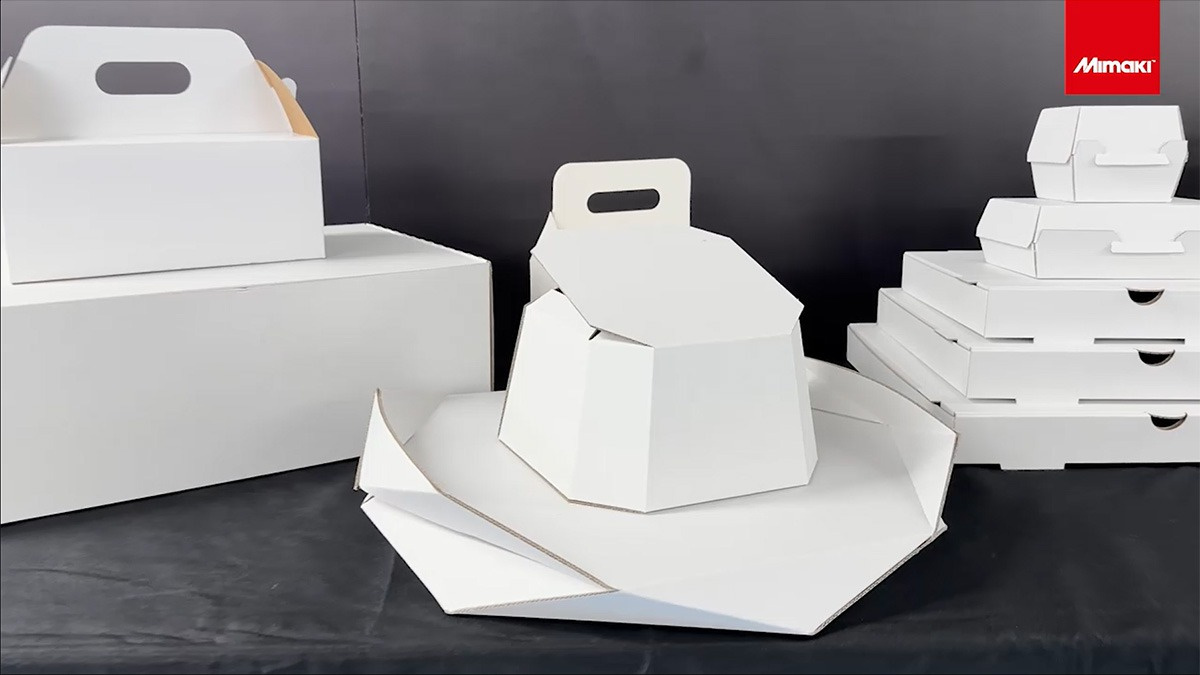
- Bringing sample production in-house for more flexible customer proposals. The CFX-2513’s high-precision cutting strengthens prototyping and proposal capabilities.: CMI

- KOJIMA Co., Ltd. (Odawara city, Kanagawa)
- From Artisans to Operators. Digitizing Artwork Printing and Gold Foiling with the UJF-7151 plusII: Sakura Seisakujo Co., Ltd.